Climate transparency has become a core business requirement. From net-zero commitments and investor pressure to regulatory disclosures and carbon taxation, organizations today must measure, manage, and report greenhouse gas (GHG) emissions accurately and consistently.
Yet carbon reporting remains one of the most complex areas of sustainability compliance. Data is scattered across departments, calculations rely on manual spreadsheets, and emission factors change frequently. This makes traditional carbon accounting slow, error-prone, and difficult to audit.
As global climate regulations tighten, companies can no longer afford delayed or inaccurate emissions data.
ZOEI ESG, an AI-enabled ESG reporting software from India with worldwide disclosure support, enables organizations to generate GHG reports in under two minutes – transforming carbon accounting from a manual burden into a strategic capability.
What is GHG Reporting?
GHG reporting measures the total greenhouse gas emissions generated by an organization’s operations and value chain. It follows the GHG Protocol, the world’s most widely used carbon accounting standard.
Emissions are classified into three categories:
- Scope 1: Direct emissions from owned or controlled sources
- Scope 2: Indirect emissions from purchased electricity, steam, heating, and cooling
- Scope 3: All other indirect emissions across the value chain
Accurate Scope 1, 2, and 3 measurement is essential for regulatory compliance, carbon reduction strategies, and ESG disclosures.
Why GHG Compliance Matters
Carbon reporting is no longer voluntary. Governments, investors, customers, and lenders expect transparency on emissions and climate risks.
Strong GHG reporting helps organizations:
- Support net-zero and decarbonization strategies
- Improve regulatory readiness
- Enhance investor trust
- Strengthen ESG credibility
In global markets, credible carbon disclosures directly impact brand value, access to capital, and long-term resilience.
Challenges in Manual Carbon Accounting
Despite its importance, many companies still rely on spreadsheets and manual data collection. This leads to:
- Data fragmentation across teams
- Complex emission factor management
- Manual calculations prone to errors
- Limited traceability and audit readiness
Energy bills, logistics data, procurement records, and travel logs often exist in different systems. Consolidating this data manually is slow, inconsistent, and unsustainable at scale.
These challenges increase compliance risks and prevent organizations from using carbon data strategically.
How AI is Transforming GHG Reporting
AI introduces automation, accuracy, and scalability to carbon accounting.
AI-powered platforms enable:
- Automated activity data normalization
- Emission factor mapping and updates
- Intelligent calculations across scopes
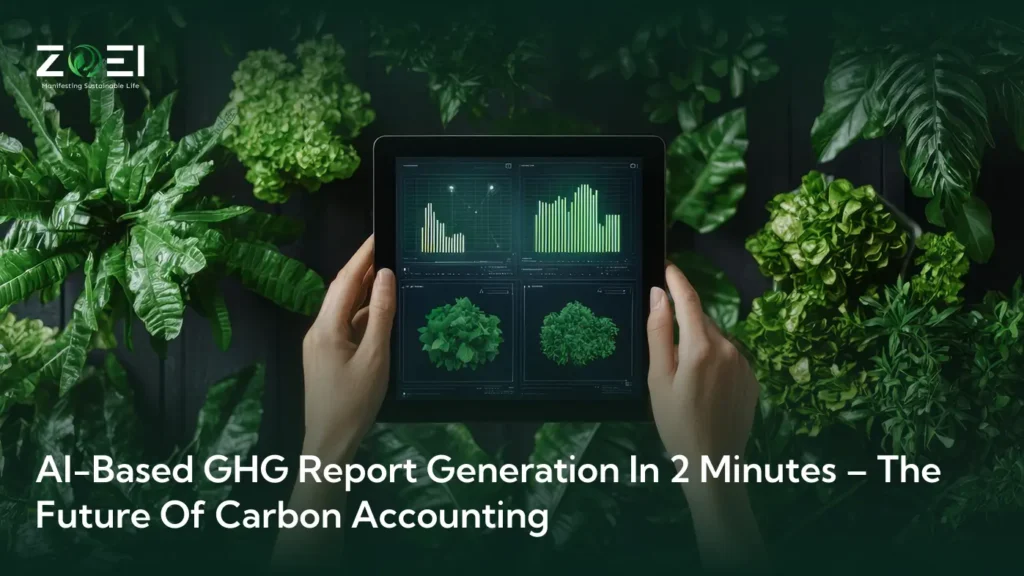
- Real-time emissions dashboards
This reduces manual intervention, ensures consistency, and enables faster decision-making.
How ZOEI ESG Supports GHG Reporting
ZOEI ESG is designed to simplify complex carbon workflows.
The platform provides:
- Automated Scope 1, 2, and 3 calculations
- GHG Protocol alignment
- Validated emission factor libraries
- Audit-ready outputs with full traceability
ZOEI ESG integrates ESG, finance, and operational data into a single platform, ensuring consistency and transparency.
Business Benefits
By adopting ZOEI ESG for carbon reporting, organizations gain:
- Faster GHG disclosures
- Reduced manual effort
- Improved emissions accuracy
- Net-zero readiness
They also gain the ability to track, benchmark, and reduce emissions strategically.
Conclusion
Carbon transparency is now a business imperative. Manual reporting methods are no longer sustainable in a data-driven regulatory environment.
With ZOEI ESG, GHG reporting becomes fast, accurate, and audit-ready – supporting both compliance and climate strategy.